
How AI is transforming CRM
Nick Rainbird • February 28, 2024

What is AI and how is it revolutionising Customer Relationship Management?
The sales world is rapidly evolving and how a company manages its customer relationships is crucial to its success. Therefore, Customer Relationship Management (CRM) systems are being adopted by organisations to stay organised and increase efficiency levels.
Artificial Intelligence (AI) is revolutionising the way in which companies engage with their customers. This includes enhancing work quality, redefining machine interfacing, providing businesses with powerful tools to analyse data, automate processes, and deliver personalised experiences. AI functionalities will be integrated within various CRM systems for sales people, marketers and human resources departments to interact with the AI technology to enhance their productivity and deliver job responsibilities more efficiently. In this blog, we'll explore how AI is ultimately enhancing and impacting CRM.
With AI algorithms, manual data entry becomes simpler whilst reducing user effort. These AI-driven tools can populate notes and follow-ups automatically, eliminating manual data input. AI algorithms analyse data from a range of sources including customer interactions, emails, and social media. The relevant information is extracted to populate CRM fields. This automated entry saves time, maintains data accuracy, and minimises human errors due to the automation of data entries.
AI augments data quality. Learning from patterns and historical data, it offers intelligent predictions and suggestions. For example, AI can recommend tags or categories based on note or email content, streamlining tasks and enhancing data consistency. AI unlocks more effective data utilisation. It analyses vast datasets, uncovering patterns, trends, and overlooked insights. This information empowers decision-making, personalises customer interactions, and elevates overall CRM performance.
AI in Sales
Predictive analytics:
In sales departments AI will compliment lead generation, lead scoring and predictive analytics. AI can analyse vast amounts of data to identify patterns and trends, helping sales teams predict customer behaviour, preferences, and potential buying signals. This enables more targeted and personalised sales strategies, improving conversion rates and customer satisfaction.
Lead scoring and qualification:
AI powered CRM systems can automatically score and qualify leads based on various criteria, such as demographic information, engagement history, and purchase intent. This helps prioritise leads for sales outreach, ensuring that representatives focus their efforts on the most promising opportunities, analyse vast amounts of customer data in real-time to uncover valuable insights and trends.
Sales forecasting:
By leveraging machine learning algorithms, businesses can gain a deeper understanding of customer behaviour, preferences, and needs by replacing dead-end, web-to-lead forms with live conversations to qualify and pass leads to your team directly from your website. These insights enable sales teams to make data-driven decisions, identify opportunities for growth, and predict future customer actions more accurately.
Process automation:
AI is also beneficial in sales in providing automated personalised communications at any location including Microsoft Outlook, Gmail and LinkedIn. With this function you will never draft emails from scratch again! AI will auto-generate personalised emails grounded in CRM and external data, helping sellers to make introductions or send follow-ups in seconds.
Overall, AI enhances CRM for sales by providing actionable insights, automating manual tasks, personalising interactions, and optimising sales performance to drive efficiency, productivity, and revenue growth for organisations.
AI in Marketing
Personalised marketing campaigns:
One of the key benefits of AI in CRM is its ability to deliver personalised experiences to customers at scale. AI algorithms can segment customers into distinct groups based on their demographics, purchase history, and behaviour and tailor marketing messages, product recommendations, and communication channels to individual preferences. This helps marketers anticipate customer needs, optimise marketing spend, and make proactive decisions to stay ahead of the competition to deliver highly targeted and personalised marketing campaigns.
Predictive analytics:
Additionally, AI can forecast future marketing trends and outcomes by analysing historical interactions and preferences. This helps marketers anticipate customer needs, optimise marketing spend, and make proactive decisions to stay ahead of the competition.
Marketing automation:
By automating repetitive tasks like email marketing, social media scheduling and lead nurturing campaigns, marketers can focus on creating compelling content and strategies that drive engagement and conversions. This saves time and resources, improves efficiency, and allows marketers to focus on more strategic initiatives.
Customer service enhancement:
AI-powered chatbots and virtual assistants integrated with CRM systems can provide immediate assistance to customers, answer frequently asked questions, and resolve issues in real-time. This level of personalisation enhances customer engagement, loyalty, and satisfaction to ultimately driving business growth, whilst improving customer satisfaction, reducing response times, and frees up human agents to focus on more complex inquiries.
Overall, AI enhances marketing teams' capabilities within CRM systems by providing data analysis, personalised marketing, lead scoring, content recommendations, automation, predictive analytics, and customer service enhancement. By leveraging AI-driven insights and tools, marketing teams can optimise their efforts, drive better results, and deliver a superior customer experience.
AI in Service
Chatbots for Self-Service:
AI automates routine tasks and processes within CRM systems, freeing up valuable time for sales and customer service teams to focus on more strategic activities. For example, AI-powered chatbots can handle routine customer inquiries and support requests, providing immediate assistance 24/7 AI-powered chatbots and virtual assistants integrated with CRM systems can provide immediate assistance to customers, answer frequently asked questions, and resolve issues in real-time. This enables customers to find answers to their questions quickly and conveniently, reducing the workload and costs on service agents whilst improving customer satisfaction, reducing response times, and freeing up human agents to focus on more complex inquiries.
Sentiment analysis:
Additionally, AI can automate lead scoring, sales forecasting and customer sentiment and emotion from various sources, such as social media, emails, and customer service interactions enabling teams to work more efficiently and effectively. AI can analyse customer interactions, such as emails, chats, and social media conversations, to determine sentiment and gauge customer satisfaction levels. This allows service teams to identify unhappy customers or potential issues early on and take proactive measures to address them by understanding how customers feel about their brand and products. Businesses can identify opportunities and address issues before they escalate. AI-powered sentiment analysis also enables businesses to engage with customers in a more empathetic and personalised manner to analyse customer sentiment, service teams can proactively address customer concerns and provide personalised solutions, leading to higher customer satisfaction and loyalty.
Automated Case Resolution:
AI can automate repetitive service tasks, such as case triaging, data entry, and follow-up communication. This streamlines service processes, reduces manual effort, and allows service agents to focus on more complex or high-value interactions.
AI enhances service teams' capabilities within CRM systems by automating tasks, providing predictive insights, enabling self-service options, analysing sentiment, offering personalised recommendations, streamlining case resolution, facilitating knowledge management, and leveraging customer feedback. By harnessing the power of AI, service teams can deliver faster, more efficient, and more personalised support experiences, ultimately driving higher levels of customer satisfaction and loyalty.
Ready to get started?
AI is revolutionising CRM by providing businesses with powerful tools to analyse data, automate processes, and deliver personalised experiences at scale. By harnessing the power of AI, organisations can gain deeper insights into customer behaviour, enhance engagement and loyalty, and drive business growth in today's competitive marketplace. As AI continues to evolve, its impact on CRM is only expected to grow, empowering businesses to build stronger and more meaningful relationships with their customers. Not sure where to start? Lets chat!
Stay Connected with ERBS
Read our latest updates
Enquire now
Get in touch

AI is good, Human judgment is better Everywhere you look, AI is being positioned as the solution to every CRM challenge. AI will transform sales. AI will revolutionise customer service. AI will eliminate administration. AI will predict your next customer opportunity before you even know it exists. AI can draft the email. But should that email be sent? In CRM, this is where human judgement matters. AI is a powerful assistant for the time-consuming / repetitive tasks that take up the working day: condensing meeting notes, drafting customer communications, identifying patterns and helping teams prioritise leads. That gives people more time to focus on the customer. It does not make their expertise less important. Where human judgement wins: A CRM system can suggest the next best action, but it cannot fully understand the complexities of a customer relationship built over years A salesperson might hear hesitation in a buyer’s voice that never appears in the Ai transcript A support team might know that a routine complaint follows weeks of frustration. The suggested response may look right on screen, but still be wrong for that relationship. Building trust, negotiating a difficult deal and deciding when to make an exception require context, empathy and accountability. AI can offer information; people still need to decide what to do with it. While AI widens the map, humans lay out the path. The strongest approach combines both: let AI handle the first draft and the repetitive work, then use human judgement to check the details, shape the response and make the final decision. Start with one time-consuming task, and ask your team what better customer conversations that saved time could make possible. The businesses seeing the greatest success with AI are not removing people from the process. They are empowering people with better information.
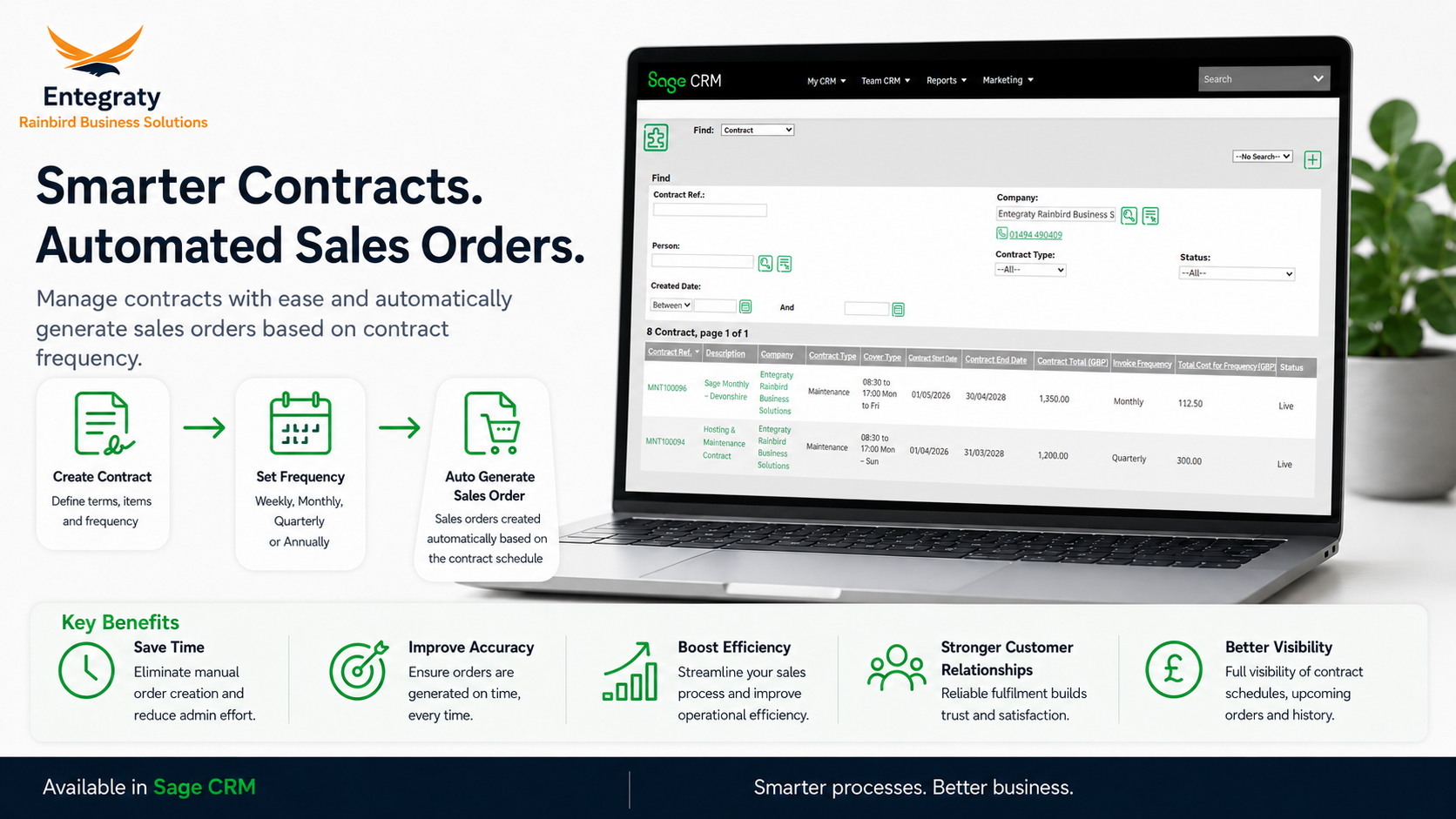
ERBS's Contracts module for SageCRM allows businesses to easily create and manage contracts, renewals and automatically generate sales orders based on the contract billing frequency, helping teams streamline operations, reduce manual effort, and improve billing accuracy. Fully integrated with Sage50 and Sage200 the auto generated sales orders can then be posted from SageCRM directly at a click of a button. Key Features: Contracts can be created directly from sales quotations or orders Supports multiple and custom billing frequencies (4 weekly, monthly, quarterly, annually) Contract and Product level Site management Process contract amendments midterm tracking historic changes and authorisations if required Easy Management of Annual Price Increases at product level Renewal and purchase order reminders and dashboards On Hold and Cancellation processes By connecting contracts directly to automated sales order generation, businesses can create a more reliable and scalable process for recurring business that help teams work smarter, improve visibility, and accelerate growth If you would like to find out more about the Contracts module for SageCRM please feel free to get in touch on 01494 490409 or email me at nick@rainbirdbusiness-solutions.com to discuss these further.
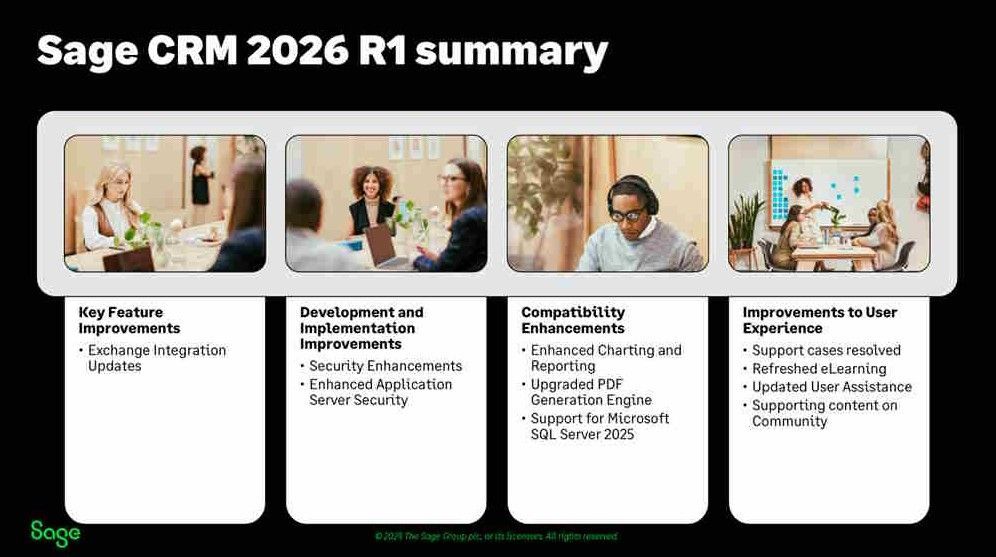
SageCRM 2026 R1 is positioned as a Security and Compatibility release, focused on reinforcing the platform’s resilience, reliability, future readiness and long-term sustainability.